Back to Blog






Monica Jansen
Nov 5, 2026
AI Infrastructure for Startups
It is no secret that AI can open up new opportunities for startups. However, the infrastructure needed to support it can come with a high price tag.
Computing power, storage, and other resources can quickly become a significant expense.
For a startup with limited funds, investing heavily from the beginning is rarely realistic, which is why finding the right balance is crucial.
Read on to learn what AI infrastructure for startups includes and what to consider when planning your setup.
- What Is AI Infrastructure?
- What AI Infrastructure Do Startups Need?
- AI Infrastructure Deployment Options
- Considerations for Choosing AI Infrastructure
- Managing AI Infrastructure Costs
What Is AI Infrastructure?
AI infrastructure is the combination of hardware, software, and systems that support AI operations. It provides the resources needed to train, deploy, and run AI models.
For startups, these components form the foundation of using AI effectively.
The exact setup can vary considerably depending on how the business is using AI, the resources it already has, and the demands of its AI workloads.
What AI Infrastructure Do Startups Need?
AI infrastructure consists of several interconnected components, but startups do not necessarily need the most advanced option in every area.
The requirements depend on the workload, its resource demands, and the technology needed to support it.
Computing Resources
Firstly, AI workloads need enough computing power to process data and perform analyses. CPUs can handle many basic tasks, while more demanding workloads often rely on specialized processors such as GPUs.
For example, training a complex model usually requires far more computing power than running a pre-trained one.
However, buying expensive hardware is not the only option.
Instead, cloud services, rented GPUs, or dedicated servers can give startups the resources they need without requiring them to build extensive infrastructure from the start.
At a larger scale, computing resources also need to be allocated efficiently.
Technologies such as containers and orchestration tools can help distribute workloads across available capacity and keep applications running consistently across environments.
Data Storage
Next, AI systems need resources to store, organize, and prepare the data they process.
Fast access is particularly important when large datasets are used for training or other demanding tasks.
Depending on the workload, raw data may also need to be cleaned, transformed, or organized before it can be used effectively by an AI model.
Various formats may need their own storage solutions, from databases for structured information to object storage for larger datasets and model files.
For startups, scalable storage makes it possible to start small and expand capacity as data volumes increase.
Networking
Additionally, reliable networking allows data to move between storage, computing resources, and AI applications.
Slow or unstable connections can create delays when transferring large datasets or sending requests between parts of the system. That is why concepts such as bandwidth and latency matter.
In this case, bandwidth determines how much data can be transferred at once, while latency affects how quickly it reaches its destination.
Both become particularly important when computing and storage resources are spread across multiple locations.
Therefore, for startups relying on cloud or remote resources, network performance can affect how well the entire setup works together.
AI Development Tools
Furthermore, teams need software for creating, training, and testing AI models.
Frameworks and libraries provide ready-made functions for common tasks, reducing the amount of code teams need to create from scratch.
Many established options are open source, which can make advanced tools accessible without adding substantial software costs.
Additionally, integrated environments can bring coding, testing, and experimentation into one workspace, making it easier for teams to refine models and compare results as a project progresses.
MLOps and Model Management
Lastly, startups need a way to manage models beyond the initial development stage.
Machine Learning Operations (MLOps) tools can help teams track experiments and model versions, so they can reproduce previous results and follow changes as models evolve.
Also, they can automate parts of the workflow between development and production, including validation and release processes.
Once a model is running, monitoring tools can track its performance and help identify changes that may require attention.
For a growing startup, these processes become increasingly useful as the number of models and experiments rises.
AI Infrastructure Deployment Options
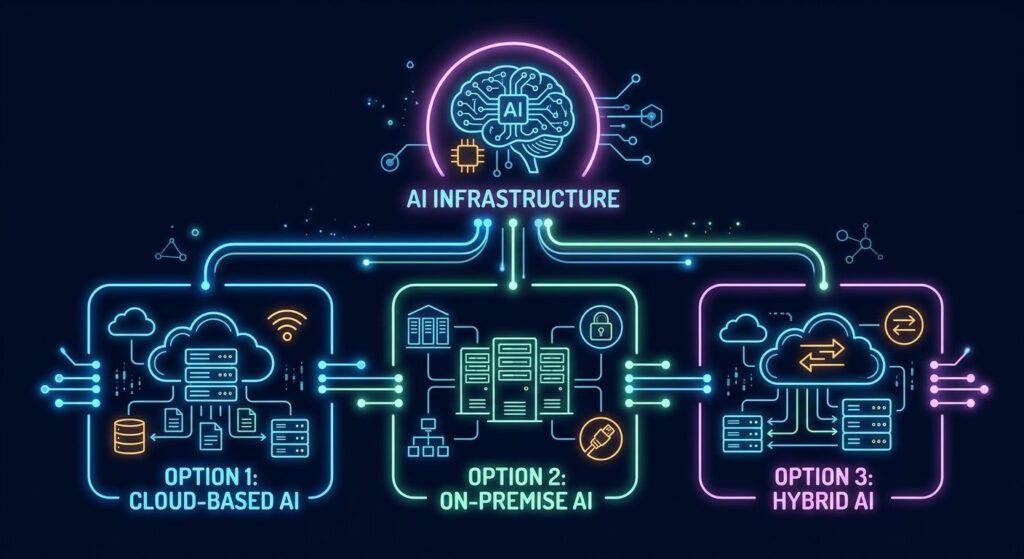
AI infrastructure can run in the cloud, on-premise, or across a combination of both. For startups, the main difference lies in who owns and manages the underlying resources.
Cloud
For one, cloud infrastructure provides computing, storage, and other resources without requiring a startup to maintain the physical hardware.
Capacity can generally be adjusted as demand changes, making this approach practical for workloads that are still evolving.
On-Premise
By comparison, on-premise infrastructure runs on hardware owned and managed by the organization itself.
This gives the business greater control over its systems and where the data is stored.
However, it also places responsibility for maintaining and managing the infrastructure on the organization, which is often untenable for startups.
Hybrid
Alternatively, a hybrid setup combines cloud resources with on-premise infrastructure.
For example, a startup may keep sensitive data or workloads within its own environment while using cloud resources for computing-intensive tasks or periods of higher demand.
As a result, it can draw on external capacity without moving every workload outside its own infrastructure.
Considerations for Choosing AI Infrastructure
Choosing the right AI infrastructure depends on what the startup needs from its setup and the resources it has available.
Before making a decision, there are several key factors worth considering:
Budget
To begin with, infrastructure costs need to fit within the amount a startup can realistically dedicate to AI.
Cloud services can reduce upfront expenses by providing resources on demand, while purchasing dedicated hardware requires a greater initial investment.
Additionally, ongoing expenses should be considered to make sure the chosen setup remains financially sustainable.
Workload requirements
At the same time, the type of AI workload has a major influence on the infrastructure needed to support it.
Training complex models generally demands more computing power and storage, while inference can have different requirements depending on the number and frequency of requests.
Therefore, understanding the workload helps determine which resources are actually necessary.
Scalability
As a startup grows, the infrastructure should be able to accommodate increasing resource needs without significant changes to the setup.
Scalable services allow capacity to expand or contract as needed, reducing the need to provision for future demand from the start.
Performance
In addition, performance requirements depend on how AI is being used and how quickly results need to be delivered.
Applications that process requests in real time may depend on low latency, while other workloads can place greater importance on processing capacity.
Technical Expertise
The chosen approach needs to reflect the technical expertise available within the team.
Managing AI infrastructure can demand considerable knowledge and time, which smaller teams may struggle to dedicate.
Thus, managed services can reduce this burden by placing more of the technical responsibility with the provider.
Security and Data Privacy
Lastly, security requirements can vary depending on the data being processed and how the infrastructure is used.
In particular, sensitive or personal information may require stronger access controls, encryption, and greater authority over where data is stored, afforded by private AI.
Legal or industry requirements can further influence the available options when they set conditions for storing or processing certain types of data.
Managing AI Infrastructure Costs
Even with a suitable setup in place, inefficient resource use can drive up infrastructure expenses.
A few ways to keep costs manageable include:
- Starting with essential resources: Avoid paying for more computing power or storage than the current workload requires.
- Using scalable services: Increase resources as demand grows instead of paying for future needs from the beginning.
- Choosing pre-trained models: Using an existing model can require significantly fewer resources than training one from scratch.
- Tracking resource usage: Identifying idle or underused capacity can help eliminate unnecessary expenses.
Conclusion
Startups don’t need to invest in every possible resource from day one.
The key is building around current requirements while leaving room for the setup to grow as the business and its AI usage develop.
Ultimately, the right infrastructure lets startups take advantage of the benefits of AI without spending more than necessary.
Author
Monica Jansen
Monica Jansen is a seasoned tech writer focused on web hosting and cybersecurity. She loves doing deep dives and whittling down difficult topics into simple and succinct concepts. Whether she is covering firewalls or different hosting plans, she always strives to provide clear guides that website owners of all skill levels can follow.
Add your comment
Get content delivered straight to your inbox



Your data.
Your choice.
Work with the best of the best — your projects deserve it.