Back to Blog





Monica Jansen
Nov 4, 2026
Who Should Consider Offshore Hosting?
Offshore hosting isn’t limited to one type of website or business.
From international companies to independent publishers, users turn to servers abroad based on their priorities and the demands of their projects.
Knowing who can benefit from offshore hosting makes it easier to understand where its practical value lies.
Below, we’ll take a look at who it is suitable for, as well as some of the most common real-world use cases.
- Offshore Hosting Explained
- Advantages and Drawbacks of Offshore Hosting
- Who Needs Offshore Hosting?
- Common Offshore Hosting Use Cases
Offshore Hosting Explained
Offshore hosting means hosting a website, application, or other online project on servers located outside the country where its owner or business is based.
However, the difference goes beyond physical location.
Hosting in another country places the server within a different jurisdiction, which can affect areas such as data privacy, content rules, and the legal requirements surrounding the service.
Additionally, the location can influence practical factors such as infrastructure, performance, pricing, and available resources.
As a result, offshore hosting can offer an environment that may be better suited to the priorities and requirements of certain projects.
Advantages and Drawbacks of Offshore Hosting
Like any hosting option, going offshore comes with both benefits and potential limitations.
What matters most depends on the location, provider, and requirements of the business.
Advantages
Firstly, offshore hosting gives you access to jurisdictions, providers, and services beyond what is available in your home country.
Depending on the location, this can mean stronger privacy protections, more flexible content policies, competitive pricing, or infrastructure that better serves an international audience.
Additionally, it can offer resources that may be limited or more expensive locally.
As a result, the main benefit lies in having more options to find a setup that aligns with what your project actually needs.
Drawbacks
On the other hand, operating across borders can introduce challenges that are less prominent when hosting locally.
Different legal requirements may take more time to navigate, while server distance can affect performance if the location is poorly matched to your audience.
Depending on the provider, time zone differences, support availability, payment methods, or unfamiliar policies may also complicate day-to-day management.
Therefore, offshore hosting works best when its advantages are relevant enough to justify the added considerations that come with hosting in another country.
Who Needs Offshore Hosting?
Offshore hosting serves a wide range of users, but it becomes particularly relevant when the standard hosting options available to a user or business don’t fully match their priorities.
Those needs can vary considerably from one project to another, which makes some groups more natural candidates than others. These include:
Privacy-Conscious Users
To begin with, individuals and businesses that prioritize privacy often have stricter requirements for how and where their information is handled.
Looking beyond local providers gives access to jurisdictions with different approaches to privacy and data protection.
Choosing one with favorable laws can provide stronger safeguards for the stored data.
In particular, this can be relevant to professionals handling confidential information, storing customer data, or working with sensitive internal records.
International Businesses
Next, companies with an international presence, such as e-commerce businesses, may have users and operations spread across several countries.
Rather than relying on the infrastructure in their home country, they can select a server location that provides reliable connectivity and consistent access across their key markets.
However, a company doesn’t need to operate globally for location to matter. Its main target audience may simply be based far from its local market.
In that case, choosing a server closer to those users can reduce latency and improve response times.
Content-Based Projects
Another reason to consider offshore hosting can come from the type of content a project publishes.
Not all types of content are treated the same way across jurisdictions.
Material that is permitted in one country may face tighter restrictions, removal requirements, or other limitations in another.
As a result, offshore servers can give such projects more flexibility over what they can publish.
In particular, this can be valuable when freedom to share information is central to their work.
Resource-Heavy Workloads
Lastly, demanding workloads can require more capacity than local hosting options are able to provide.
High traffic, large amounts of data, and complex processing can quickly increase the resources needed to maintain reliable performance.
In such cases, offshore providers may offer the capacity or server configurations required to support workloads that would otherwise be difficult to accommodate.
Access to those resources can also make the setup easier to scale as demand grows.
Common Offshore Hosting Use Cases
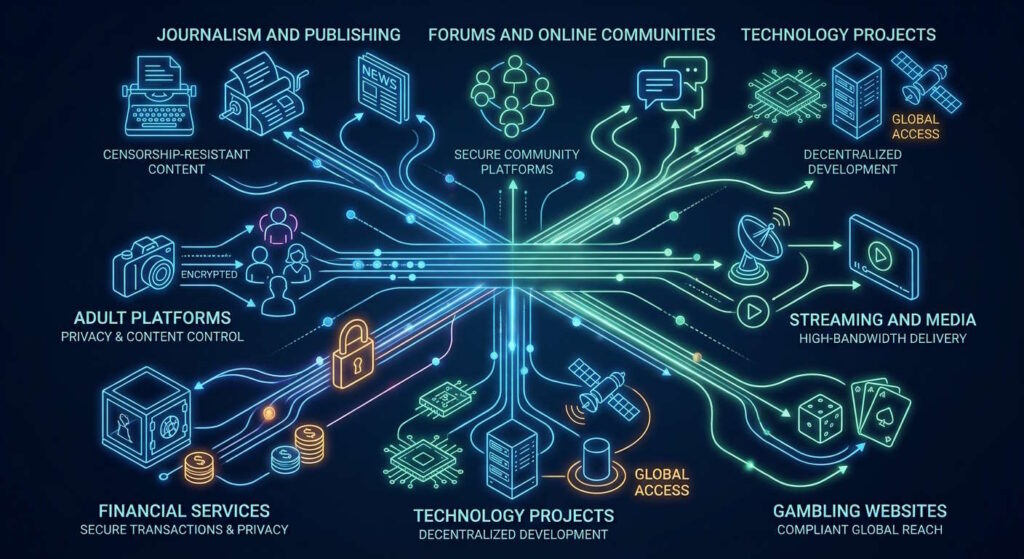
Offshore hosting can offer more control, fewer restrictions, and access to infrastructure beyond your local market. Some of its most common use cases include:
Journalism and Publishing
Firstly, journalists and independent publishers can deal with information that attracts scrutiny or is sensitive by nature.
Investigative reporting, political commentary, and coverage of controversial topics may face restrictions or pressure depending on where the content is hosted.
In these situations, offshore hosting may open up jurisdictions with broader protections for freedom of expression and stronger privacy measures to safeguard sensitive information from unnecessary exposure.
Forums and Online Communities
Yet another common use case is forums and online communities, where much of the content comes directly from users.
As these platforms grow, they may need to manage large volumes of posts, conversations, and other user-generated material.
At the same time, the range of viewpoints and topics being discussed can make the rules of the hosting jurisdiction particularly important.
More flexible content policies can give these communities greater freedom while accommodating the demands of an active platform.
Adult Platforms
Countries and providers may place limits on adult content or exclude it from their services altogether.
As a result, finding infrastructure that explicitly allows this type of website is an important consideration.
Adult platforms can also generate substantial traffic and serve large amounts of media, making bandwidth and reliable performance available through offshore hosting particularly relevant.
Streaming and Media
Streaming and media services have particularly demanding infrastructure needs due to the amount of data they deliver.
Namely, video and large media files can consume considerable bandwidth, especially when many users are accessing them at the same time.
Moreover, audiences may be spread across different regions, making server location and network connectivity key factors in maintaining smooth delivery.
Consistent availability is equally important, as interruptions can immediately affect viewers trying to access live or on-demand content.
Financial Services
On a different front, financial platforms such as crypto exchanges, payment processors, and trading systems depend heavily on reliable infrastructure.
Many of them operate across borders while continuously processing transactions and handling sensitive data. As such, uninterrupted access is essential to their operations.
At the same time, reaching multiple markets means dealing with different regulatory environments.
Therefore, the location of the infrastructure needs to align with the requirements that apply to each service.
Technology Projects
From a technical perspective, offshore hosting can suit projects that require more control over their server setup.
SaaS applications, development environments, and AI/ML workloads can have specific requirements for processing power, storage, or software configurations.
In particular, access to flexible server configurations makes it easier to tailor the infrastructure to the project, instead of working in a limited setup.
As demand changes, resources can scale alongside the application without forcing a move to an entirely different system.
Gambling Websites
Finally, gambling platforms operate in an industry where the rules around online betting and casino services can differ considerably between jurisdictions.
Licensing requirements and restrictions can affect where they are permitted to operate and how their services are provided.
As a result, the hosting location can become an important part of meeting the conditions that apply to the business.
Additionally, gambling websites can require infrastructure that supports continuous access and large numbers of simultaneous users, particularly during major sporting events or popular games.
Conclusion
Offshore hosting can be valuable when your project demands more than local hosting can provide.
For some, that means greater privacy and more freedom over the content they publish.
For others, the advantage lies in reaching audiences abroad or accessing infrastructure capable of supporting demanding workloads.
The value extends even further when local laws, restrictions, or limited hosting options stand in the way of achieving your goals.
Ultimately, offshore hosting gives individuals and businesses more liberty to choose where their online presence is based and how they can leverage it.
Ready to see what offshore hosting could offer you? Reach out to us, and let’s discuss your options!
Author
Monica Jansen
Monica Jansen is a seasoned tech writer focused on web hosting and cybersecurity. She loves doing deep dives and whittling down difficult topics into simple and succinct concepts. Whether she is covering firewalls or different hosting plans, she always strives to provide clear guides that website owners of all skill levels can follow.
Add your comment
Get content delivered straight to your inbox



Your data.
Your choice.
Work with the best of the best — your projects deserve it.