Back to Blog




Monica Jansen
Aug 3, 2026
How To Secure Sensitive Data in Cloud Environments
In the past decade, the cloud has completely transformed how businesses store, process, and manage their data.
From startups to large corporations, moving to cloud environments can bring incredible benefits like:
- Scalability
- Flexibility
- Cost efficiency
Yet, with all these advantages comes one unavoidable concern: security.
Unlike traditional on-premises systems, where you have full control over your infrastructure, the cloud is a lot more elusive when it comes to security concerns.
As such, it can leave you exposed to a wide range of risks and lead to data and financial losses.
In this article, we’ll walk you through the most common security challenges in cloud environments, the guiding principles you should follow, and a set of best practices that will help you protect your data—whether you’re new to the cloud or already running a complex, multi-cloud setup.
- What Exactly Is the Cloud?
- Understanding Cloud Security Challenges
- The Core Principle of Cloud Data Security
- Best Practices for Securing Data in Cloud Environments
Read on!
What Exactly Is the Cloud?
The cloud refers to a network of remote servers and data centers that store and manage data, run applications, and deliver services over the internet.
By storing your data, site, or app on the cloud, you erase the need for your own hardware. Instead, everything is kept in a virtual space that you share with other users.
You can easily compare paying for cloud storage to the way you do for electricity.
Instead of buying your very own generator, you pay your utility company to give you access to electricity instead. The same goes for using the cloud for storage as opposed to buying separate hardware.
The main advantages of the cloud are:
- Instant remote access
- Reliability
- Pay-as-you-go pricing
- Better accessibility
However, it has just as many disadvantages, the most important of all being the potential security risks it poses.
We’ll go into them below.
Understanding Cloud Security Challenges
Before you can secure your cloud environment, you need to understand what you’re up against.
While cloud platforms are powerful, they introduce new security challenges compared to traditional IT:
- Data breaches: Since the cloud is publicly accessible, misconfigured storage buckets or weak access controls can expose sensitive information to everyone using it.
- Insider threats: Whether malicious or accidental, they can lead to unauthorized access or data leaks.
- Malware and ransomware attacks: Attackers know that disrupting access to business-critical data can force organizations to pay up quickly, which is why they increasingly pick them as targets.
- Compliance and regulations: Many industries are governed by strict rules around data handling (like GDPR or HIPAA). While your provider may offer compliance-ready infrastructure, you’re still responsible for configuring it correctly to stay within the law.
Understanding these challenges is the first step to creating a security plan that actually works.
The Core Principle of Cloud Data Security
Now that we’ve covered the risks, let’s move on to the foundations of protecting data in the cloud.
Shared Responsibility
The first concept to understand is the shared responsibility model, upon which the cloud rests.
According to this model, your cloud provider handles things like the physical security of data centers, patching the underlying hardware, and offering secure infrastructure.
Personal Responsibility
You, on the other hand, are responsible for how you configure services, manage access, and protect the data you upload.
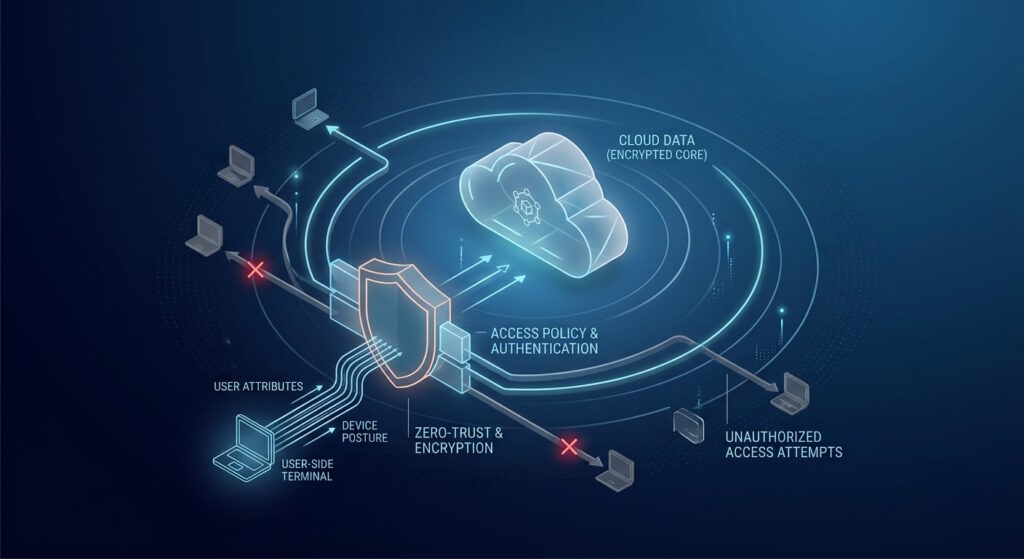
In other words, you are responsible for protecting your own data. For this reason, it’s worth adopting a zero-trust mindset.
Namely, instead of assuming everything inside your cloud network is safe, zero trust works on the principle of “never trust, always verify.” Thus, every access connection attempt, no matter where it comes from, needs to be heavily verified and monitored.
Keeping these principles in mind will help you put security first and protect your data from any potential breaches.
Best Practices for Securing Data in Cloud Environments
Here are the best tips for ensuring all your data is fully safe in the cloud.
Data Encryption
Encryption is one of the strongest tools you can use to protect sensitive information. Put simply, encryption strategies take your data, scramble it, and provide you—and only those you choose—with the unscrambling key.
As such, it ensures that even if someone gains unauthorized access, the data they see is useless without the right key.
Now, you should always encrypt data at rest (when stored in the cloud) and in transit (when moving between users, applications, or cloud services).
When it comes to encryption keys, you can rely on provider-managed keys for simplicity, or opt for customer-managed keys if you need more control.
Whichever option you choose, remember to rotate keys regularly and store them securely to reduce the risk of them being compromised.
Improve Password and Authentication Policies
Your data is protected by passwords in the cloud, and they are your first layer of defense against breaches.
Thus, you have to ensure the passwords you use are strong and as impenetrable as possible. You can do this by:
- Never using the same set of passwords for everything: The combination you use for cloud access has to be separate from everything else.
- Being original, with many different characters: That means including differently capitalized letters, random numbers, and punctuation marks.
- Changing your password at least once a month: That way, you will reduce the risk of your data being stolen even more.
Now, although a strong password is essential, it is also smart to use additional authentication methods alongside it.
That can include one-time access codes sent to your phone, your fingerprint, a physical access key, or any other authentication method of your choosing.
By expanding and strengthening the authentication process, you’ll make cracking your password—and stealing your data—next to impossible.
Implement Strict Access Control
Access controls are mechanisms, policies, and procedures that establish who gets access to specific data, resources, applications, and so on.
Put simply, you get to decide which individuals have access to which data, greatly minimizing the risks of exposure.
When it comes to access controls, it is best to implement the least privilege principle.
It works quite simply, with users being given access to only those apps or bits of data that they need to complete their tasks.
This role-based access control can be an excellent tool for protecting sensitive data stored in the cloud, simply because it ensures that only a select few can access it.
Monitor All Cloud Activity
By monitoring all cloud activity on a regular basis, you can detect any suspicious activity and prevent breaches.
Most cloud service providers—or hosting services—offer cloud monitoring packages. They can alert you of anything that needs your immediate attention, therefore lowering the risk of attacks.
Additionally, these monitoring services can help you keep an eye on all cloud logs and audit trails.
Consider Automation
You can also use automation tools that scan your environment for potential misconfigurations, like open storage buckets or overly permissive access rules.
In this case, AWS GuardDuty, Azure Security Center, and Google Cloud’s Security Command Center are good examples.
With such services at your disposal, you can keep track of every single activity taking place in your part of the cloud.
Ensure Better Network Security
We’ve already covered passwords and authentication methods, as they are your first line of defense.
However, if you want maximum protection, you will need to make sure your entire network is secure, and:
- Employ a sturdy firewall: this firewall and intrusion detection/prevention systems (IDS/IPS) will block malicious traffic and monitor suspicious activity.
- Use network segmentation techniques: By doing so, you will separate your network into different departments containing distinct parts of your data. That will, in turn, make it harder for attackers to move laterally if they gain access.
- Rely on secure VPNs: use these or private links instead of exposing resources directly to the internet. This reduces the attack surface significantly.
A little bit of diligence goes a long way here, and will help you keep most of the threats at bay.
Establish a Solid Backup and Recovery Plan
No matter how strong your defenses are, you need a solid backup and recovery plan. After all, accidents and attacks can still happen.
So, you should make sure your backups are automated and frequent, and store them in multiple regions to avoid data loss due to localized outages.
However, keep in mind that it’s not enough just to have backups—you need to test your recovery process regularly.
That ensures that when disaster strikes, you can actually restore your data quickly and with minimal disruption.
Finally, for some extra protection, you should consider immutable backups that cannot be altered or deleted. These are especially useful in defending against ransomware attacks.
Conclusion
Securing all data and applications in the cloud is crucial for all companies using the cloud for storage.
By understanding the challenges, following core security principles, and applying best practices like encryption, authentication protocols, secure configurations, backups, network protection, and incident response, you can dramatically reduce your risks.
If you follow our tips closely, you will make sure that your data stays safe and far away from prying eyes—no matter which part of the cloud you utilize.
Author
Monica Jansen
Monica Jansen is a seasoned tech writer focused on web hosting and cybersecurity. She loves doing deep dives and whittling down difficult topics into simple and succinct concepts. Whether she is covering firewalls or different hosting plans, she always strives to provide clear guides that website owners of all skill levels can follow.
Add your comment
Get content delivered straight to your inbox

Your data.
Your choice.
Work with the best of the best — your projects deserve it.