Back to Blog






Monica Jansen
Mar 3, 2026
What Is Offshore Hosting and Why Is It Important?
In today’s online world, privacy is hard to come by, and data laws vary wildly from one country to another. That’s why choosing a good hosting service matters more than ever.
If you want more control, better privacy, and robust protections, regular hosting solutions aren’t always the best options.
That’s where alternative approaches come into play.
One such alternative—offshore hosting—has become incredibly popular in recent years.
In the sections that follow, we’ll go over its definition, features, and advantages, and reveal why this hosting type is the best decision you can make for your website.
- What is offshore hosting
- How does offshore hosting work
- Why offshore hosting is important
- Is offshore hosting legal?
- Top offshore hosting locations
- Types of offshore website hosting
- Who should use offshore hosting?
- The potential drawbacks
- Is offshore hosting right for you?
- How to choose a reliable hosting provider
Read on!
What Is Offshore Hosting?
Offshore hosting refers to hosting websites, apps, or any other online content on servers located outside of your own country. By using these servers, you’d be adhering to a certain foreign country’s laws and regulations and using its infrastructure for your hosting needs.
This can offer distinct advantages when it comes to avoiding censorship, complying with strict privacy regulations, or protecting content that may be restricted or penalized in your own country.
For instance, let’s say you live in Iran and want to start a porn site. The country's strict anti-pornography laws would make that impossible. However, if you make sure your website is hosted on a website in a region with laxer laws, you won’t have any issues.
It’s also worth noting that “offshore” doesn’t automatically mean shady or illegal, as many believe. In fact, many legitimate businesses turn to offshore hosting for perfectly valid reasons: to avoid overly aggressive copyright enforcement, to operate in multiple legal environments, or to simply have more freedom in how they manage their digital presence.
How Does Offshore Hosting Work?
Offshore server hosting involves storing your website’s files on servers located in a different country than your own.
Below, we will outline how the offshore process works and shed some light on all the aspects that you need to pay attention to.
Server Selection
First, you need to pick a provider based in a jurisdiction that aligns with your specific needs. Those could be stronger privacy protections, less censorship, or better proximity to your target audience.
Data Transfer
Next comes data transfer.
This process includes uploading your website’s files—such as HTML, images, and scripts—to the offshore servers of your choice. This step is typically done through an FTP client or a web-based control panel. In that regard, it is quite similar to regular hosting.
Domain Configuration
Step three is domain configuration.
The provider uses DNS (Domain Name System) settings to point your domain to its offshore servers. As a result, when people search for your web address, their browsers know exactly where to retrieve your site’s data.
Website Access
When a user visits your website, their browser sends a request to the offshore server. The server then processes that request, retrieves the necessary files, and sends them back to the user’s browser. In turn, the browser displays the site, and the user can view it.
Maintenance and Security
On the operational side, your hosting provider is responsible for server maintenance, security updates, and the overall performance of your site. Their job is also to monitor for threats and ensure that the infrastructure is reliable and runs smoothly.
Legality
At the same time, legal and regulatory considerations still apply. The provider must comply with the laws of its own country, while you must ensure that your use of the service aligns with the regulations in your own jurisdiction.
Management and Support
Lastly, most offshore hosting providers offer customer support for technical issues and account management. This support is usually available through channels like email, chat, or phone, and it helps you manage your setup more effectively and solve any ongoing issues.
Why Is Offshore Hosting Important? Diving Into the Benefits
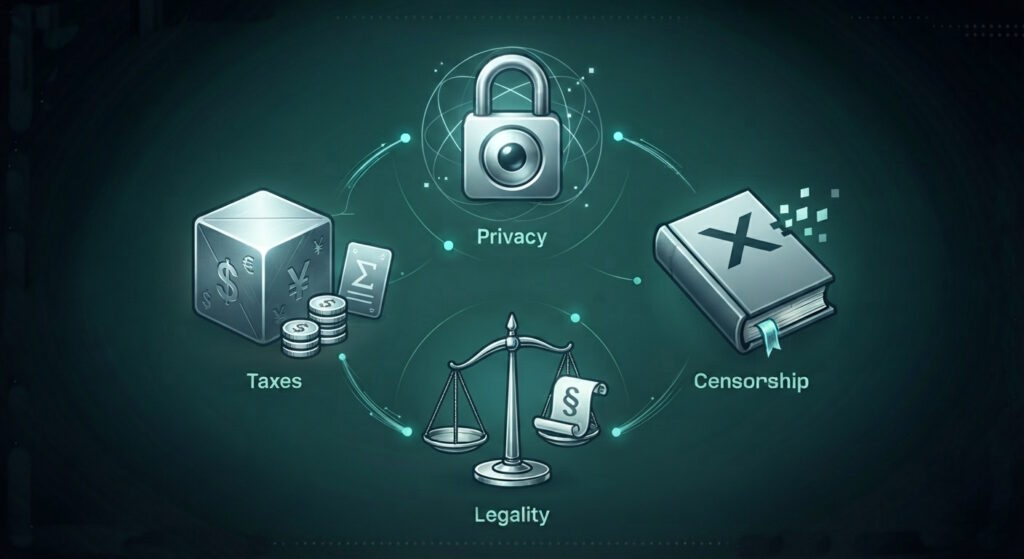
Offshore hosting offers a slew of advantages to users. They include:
- Better privacy and data protection
- Protection against censorship
- More legal flexibility
- Better reach
- Tax benefits
- More diverse payment options
- Higher level of anonymity.
We go into all of them in detail below.
Better Privacy and Data Protection
One of the most appealing aspects of offshore hosting is its strong focus on user privacy. Most offshore hosting providers operate in countries with strict data privacy regulations.
As a result, businesses and individuals can take advantage of an additional layer of protection against data collection, unwanted surveillance, or overreaching government requests.
Many offshore hosts deliberately keep minimal user activity logs, meaning they don’t store information about your activity or identity. That can be especially useful to websites containing politically sensitive information, as well as those handling personal user information.
At a time when personal and business data are regularly collected, sold, or leaked, the added privacy can make a significant difference, which is why many opt for offshore hosting.
Censorship Protections
The issue is that they often do so under vague laws that cite national security, hate speech, or public order as possible reasons for censure.
As a result, domestic hosting can become a liability for internet users, content creators, artists, journalists, or organizations whose work might challenge government narratives or touch upon taboo topics.
Their servers can be shut down, content removed, or entire websites blocked overnight, often with zero warning.
By hosting your content in countries with laxer censorship rules, you can bypass these issues more easily.
It also allows you to operate with a degree of independence from your local internet regulations, helping you maintain access to a global audience.
While it’s not a guarantee against takedowns, offshore hosting does create a buffer, especially when the host is in a jurisdiction that values freedom of speech.
Better Legal Flexibility
Every country has its own laws and regulations on intellectual property, copyright, adult content, and political speech.
Choosing to host your website on servers in countries where those laws are more relaxed can give you a legal advantage.
Content that falls under the DMCA is a good example. While posting it will lead to copyright strikes in the US, the content might be—and usually is—fully legal in other jurisdictions.
This legal flexibility is useful for gray-area websites such as torrent indexes, whistleblower platforms, crypto services, adult platforms, or even controversial blogs.
It allows webmasters to operate without the constant threat of lawsuits or takedowns from overly strict regulators or aggressive copyright holders.
Of course, it is important to note that picking an offshore host does not make you exempt from all legal responsibility.
But in many cases, it can protect you from local laws that might be too restrictive or politically motivated.
Better Reach and Tax Benefits
Another important advantage of offshore servers is their geographic location.
Specifically, certain countries—like Monaco, the UAE, or the Bahamas—are seen as tax havens, as they offer better tax rates.
By hosting in these locations, you can save money that you can then invest in growing your business even further.
Moreover, choosing a particular offshore location is a smart business move if you are targeting a specific group of people.
For instance, if you are targeting audiences in Asia, it makes more sense to pick an Asia-based hosting provider than, say, one based in North America.
Doing so, you will ensure your target audience enjoys better loading times and has an overall better user experience.
Alternative Payment Options and Anonymity
Finally, better financial privacy is another perk of offshore web hosting.
Many providers accept cryptocurrencies along with other, more traditional payment options.
As a result, users can sign up without linking a credit card or revealing any other identifiable financial information.
Some providers take things even further and allow signups with few KYC (Know Your Customer) requirements.
Combined with strong encryption, this can help you maintain both financial and personal privacy when setting up and managing your online infrastructure.
Thus, if you are located in politically unstable regions or want to avoid surveillance from competitors or hostile entities, offshore server hosting is the way to go.
Is Offshore Hosting Legal?
Yes, offshore hosting is legal. However, whether your setup is compliant depends on more than just where your server is located. You need to consider both the laws of your home country and those of the hosting provider’s jurisdiction.
Staying compliant with your local regulations is key, especially around data protection and privacy. For example, if you are subject to GDPR, your offshore provider still needs to meet comparable standards.
At the same time, the laws of the host country matter just as much. Different jurisdictions have their own rules on data handling, content, and internet usage, and you will be expected to follow them.
Compliance goes beyond just data and privacy protections. The content you host must also be legal in both locations. If it violates laws in either country, you could face legal penalties.
Finally, it’s important to pay attention to tax obligations and jurisdictional complexities. Offshore setups can create tax implications in both locations and make legal disputes more complex. That is why it is essential to understand how all of these issues are handled upfront.
Top Offshore Hosting Locations
The choice of offshore server location is rather important, as it impacts the benefits you enjoy. Different countries offer distinctive benefits in terms of privacy, censorship protections, costs, and market access.
Here is a reference guide to some of the most commonly recommended locations:
- Switzerland — has strong privacy laws, high stability, and premium infrastructure, making it a prime location for security-focused users.
- Netherlands — offers excellent connectivity and flexible internet laws, making it ideal for global, content-heavy platforms, as well as adult sites.
- Singapore — provides a pro-business environment with strong IP protection, and is an excellent choice for those targeting Asian markets.
- Iceland — has lower cooling costs and uses renewable energy, so it is fantastic for eco-conscious, data-heavy operations.
- Panama — has solid privacy laws and fewer regulatory constraints, making it a good option for those who want to avoid censorship.
Types of Offshore Website Hosting
Offshore server hosting comes in different forms, each suited to unique traffic, control, and performance needs. Choosing the right type for your website depends on how much flexibility and resources it requires.
You can pick between:
- Shared offshore web hosting
- VPS offshore web hosting
- Dedicated offshore web hosting
Here are some details on each option.
Shared Hosting
Shared hosting is the most cost-effective option you can go for. It involves multiple websites sharing a single server’s resources.
As such, this type of hosting works well for small sites and low-traffic projects, including personal blogs. It is quite cheap, making it perfect for beginners.
The main downside of shared hosting is that your website’s performance is tightly linked to the other platforms that share the same resources. If one site’s performance spikes, it might hog all the resources and render your platform inaccessible.
VPS Hosting
On the other hand, VPS (virtual private server) hosting offers you a higher level of control, as well as more resources.
With this type of hosting, a server is divided into multiple smaller, virtual servers. Each of them has its own dedicated resources, meaning that it offers you more control, better stability, and improved performance. These qualities make it a strong choice for all growing and mid-sized websites.
Dedicated Hosting
Finally, dedicated hosting provides an entire physical server for your use. It ensures maximum control, stellar performance, and great security. As such, it is ideal for high-traffic websites or resource-intensive applications that demand high, consistent reliability.
Best Practices for Protection When Using Offshore Hosting
While choosing a server located in a different country does come with strong security advantages, you will still need to ensure you have proper safeguards on your end.
A few of the core practices outlined below will go a long way in keeping you secure, no matter where your hosting provider is based.
Pick a Reputable Host
Working with a reputable offshore provider is pivotal for security. Such a company always has a solid track record, verified security standards, and support that you can count on.
Put simply, a trustworthy host is your first line of defense against potential risks, so choosing it carefully is of utmost importance.
Employ Sturdy Security Measures
Next, you should enable SSL/TLS encryption, set up a firewall, and ensure robust DDoS protection measures are in place. These baseline protections will help prevent unauthorized access and some of the most common attacks and breaches.
Update Your Software Regularly
It’s just as essential to regularly update your operating system, server, and applications with all newly released patches. Most of the time, these updates address security and performance issues, helping you protect yourself better.
Since new updates are released often, it is smart to enable automated updates. That way, everything will be up to date without you having to lift a finger.
Strengthen Access Controls
Another important tip is to use strong, unique passwords for all your hosting-related accounts, as well as to enable multi-factor authentication (MFA) wherever possible. Doing so will significantly reduce the risk of unauthorized access and misuse.
Make Regular Backups
Finally, you should back up your data, databases, and configurations as frequently as possible. In addition, they should be stored securely offsite, so that physical server damage would not affect them.
Thanks to these backups, you will be able to quickly recover your website and resume operations in case something goes wrong.
Who Should Use Offshore Hosting?
Typically, offshore server hosting is the best option for businesses and individuals that require high-level data privacy, freedom from strict local content regulations, and strict regulatory compliance.
Such companies and entities include:
- FinTech platforms, which operate across borders and are bound by various regulatory zones
- iGaming operators looking to expand their reach
- SaaS and eCommerce providers with global audiences
- Media and streaming platforms that need jurisdictional freedom
- Gambling platforms that operate in areas where the practice is frowned upon
- Adult platforms posting R-rated content
- Content creators, including bloggers, journalists, and whistleblowers.
Potential Drawbacks of Offshore Hosting
Offshore web hosting can be a smart move, but only if you actively manage all the risks that come with it. Here is a practical checklist of the potential drawbacks to watch out for before and after you go offshore.
Legal and Regulatory Exposure
Operating across two (or more) legal systems is not an easy feat, especially if their regulatory practices clash. In case something goes wrong, jurisdictional conflicts and unfamiliar regulations can quickly turn a simple issue into a drawn-out legal headache.
To that end, it’s essential to learn all that you can about all relevant jurisdictions and be up to date with all your compliance obligations.
Data Access and Control
Hosting your data on a faraway server can cause significant problems. Distance, local infrastructure limits, and even government action can make accessing your data more complicated than expected. That is especially the case in unpredictable, high-pressure situations.
That is why it is pivotal to pick a location that has historically been a reliable and peaceful spot, especially when it comes to government influence.
Performance and Reliability
Offshore servers don't automatically ensure stellar global performance. In reality, if your audience is far from your servers, latency can easily become an issue. In some regions, there is also the issue of inconsistent uptime due to weaker infrastructure.
To avoid this problem, always pick your offshore hosting provider with your target audience in mind.
Support Issues
When your provider operates in a different timezone or uses another language, support isn’t always immediate or seamless. What should be a quick fix can stretch into hours of endless back-and-forth, potentially causing your business and users to suffer.
Opting for a provider that has 24/7 support in a language that you are fluent in is, therefore, a must.
Reputational Considerations
Though it is unwarranted, offshore hosting does carry a certain amount of baggage. Clients, partners, or regulators may associate it with risk, opacity, or non-compliance, even if what you are doing is completely above the board.
This fact is something that is worth factoring into your broader strategy, no matter what type of website you run.
Hidden Costs
Many offshore hosting solutions are attractive because they appear cheaper than onshore options. However, the price tag is not always what it seems. Between currency conversion, legal overhead, and ongoing maintenance, you may end up paying more in the long haul.
To make sure you are making the right decision for your means, plan out your budget keeping these considerations in mind.
Limited Legal Recourse
Lastly, if you run into trouble with your offshore provider, resolving things won’t be as straightforward as it would be locally. Cross-border disputes are often slower, more complex, and significantly more expensive to handle.
That is an important factor to consider while making the decision whether to go offshore or pick a local host.
Is Offshore Hosting Right for You?
Although it comes with many advantages, offshore hosting isn’t a good solution for every business and individual out there.
If you are on the fence about whether this type of hosting fits your needs, here are some basic questions that you should answer to make your decision-making process easier.
Do you put privacy and data protection first?
If you are truly worried about censorship and government surveillance, or if you do not think your country’s data protection laws are good enough, offshore hosting is a good option.
Do you handle sensitive data?
Picking an offshore host located in a country with strong privacy laws can help you shield any sensitive information pertaining to your users.
Are your local laws limiting your operations?
If your home country laws are prohibiting your business from reaching its full potential, looking for a provider elsewhere is a logical step.
Where is your target audience located?
If you want to target users that live far away from you, picking a provider that’s closer to them is a smart strategic move.
Do you want to save money?
If you are positive that hosting in an offshore location would be cheaper, it’s the best decision you can make.
Can you afford potential legal fees?
If you aren’t sure that you will be able to cover all legal fees in case of a dispute with your offshore host, it is best to stick to a local option.
Are you prepared to face accessibility and support issues?
If you are not ready to account for potential language barriers, time zone differences, and remote data access issues, offshore hosting might not be a good solution.
Are you managing a resource-intensive site?
If you need easily scalable services and resources, going for an offshore host is one of the best decisions you can make.
How to Choose a Reliable Hosting Provider
Picking a reliable provider is essential to ensure you can reap all the benefits of offshore hosting.
Here’s what you should look out for while hunting for the best company for you.
Geographical Location
For starters, you will need a company with servers based in a geographically advantageous location, just like Abelohost. Our servers are located in strategic regions all around the globe, ensuring every client can find a solution that suits them
Now, picking the very best locations for offshore hosting will mean little if your target audience is too far away. So, go for a location that will ensure minimal latency and connectivity issues.
Also, make sure that the legal environment of the hosting provider of your choice aligns with your privacy and data protection needs.
Reputation
Next, you need to check independent reviews, forums, and customer feedback about every provider you consider.
You should look for red flags like frequent downtime, ignored support tickets, or sudden service changes. If you see that a company has any or all of these problems, it’s best to move on and continue searching.
Generally, a good rule of thumb is to look for companies that have been in business for several years. Take Abelohost as an example—with over a decade in the industry, we know offshore hosting like the back of our hand.
Customer Support
When choosing offshore hosting, the real difference comes from support you can actually rely on. A team that’s reachable around the clock—whether by chat, phone, or email—can make or break the entire experience.
It also helps if they are knowledgeable, tech-savvy, and experienced, so that they can solve problems before they slow you down. Abelohost offers that and more, and you can see for yourself by getting in touch with us.
Pricing
Last but not least, do your due diligence when it comes to pricing.
Pick a provider that is fully transparent about its prices and will impose no hidden or added fees. Also, make sure that the company of your choice has scalable plans that will allow your business to grow with time.
And remember: sometimes, paying a little more for a solution that offers better privacy and scalable plans is a worthy investment.
Bringing It All Together: The Case for Offshore Hosting
Offshore hosting offers a lot more than just less oversight and better financial solutions.
It provides webmasters with more control, which is crucial for those who need more flexibility, privacy, or legal breathing room.
However, it’s important to remember that it’s not a one-size-fits-all solution. Offshore hosting comes with its own risks, responsibilities, and learning curve.
As long as you value autonomy and are willing to do your homework, it can be a smart, strategic choice that takes your business to new heights and makes it thrive.
Contact Us, and Let’s Talk Offshore Hosting
Author
Monica Jansen
Monica Jansen is a seasoned tech writer focused on web hosting and cybersecurity. She loves doing deep dives and whittling down difficult topics into simple and succinct concepts. Whether she is covering firewalls or different hosting plans, she always strives to provide clear guides that website owners of all skill levels can follow.
Add your comment
Get content delivered straight to your inbox



Your data.
Your choice.
Work with the best of the best — your projects deserve it.