Back to Blog



Monica Jansen
Jul 21, 2026
What Is a DDoS Attack?
Let us paint you a picture.
Imagine that you are in your car, on the way home from work, and you reach the huge bridge you have to cross every day.
However, today, it's swarmed with a bunch of cars, and they’re just sitting there and disrupting traffic, keeping you stuck in the same position for hours.
This traffic jam is, essentially, what happens during a DDoS attack. The only difference is, you’re trying to access a website, and the cars are actually bots that are preventing you from doing so.
Unfortunately, DDoS attacks are quite common in the online world, and knowing how to mitigate them is the key to success.
In the sections that follow, we’ll give you the low-down on these attacks, list all potential types, and teach you how to protect yourself and your website by:
- Providing a Definition of DDoS
- Covering the Types of DDoS Attacks
- Explaining How These Attacks Work
- Going Over Why They Occur
- Showing Who Is Most at Risk
- Giving You Advice On Protecting Your Site
- Exploring Hosting Plans With Built-In Protection
Read on!
Definition Time: DDoS Attacks Explained
DDoS stands for Distributed-Denial-of-Service, and this name explains what these attacks are quite well.
For starters, the attacks come from various sources, making them distributed.
In addition, the aim of the attacks is to send fake connection requests, flooding a site with a massive amount of traffic that it can't handle, thus denying people access to the service it offers.
Types of DDoS Attacks
Depending on the part of the computer network they target, DDoS attacks can be classified into various groups.
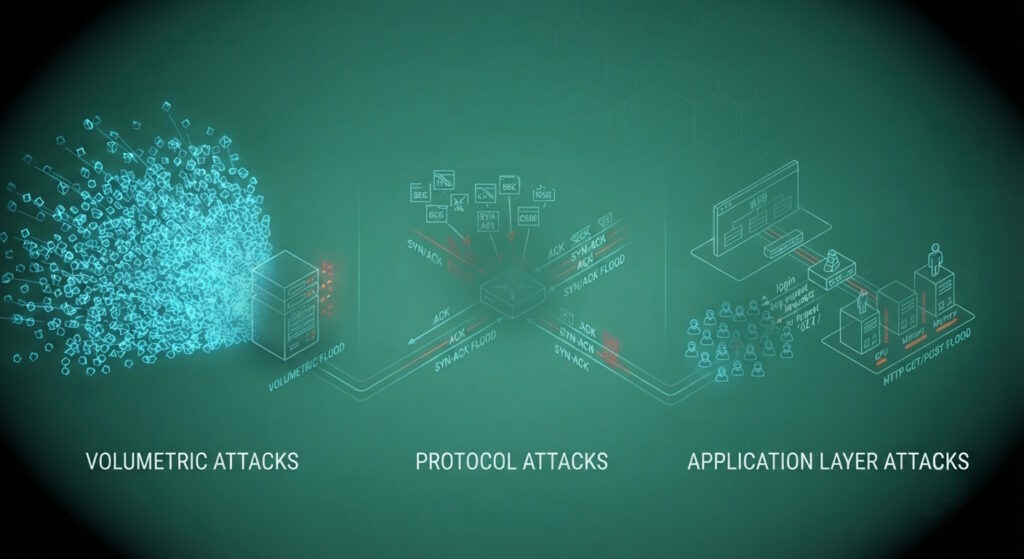
Volumetric Attacks
The main focus here is on the network bandwidth, overwhelming it and making it completely unavailable to legitimate users.
A DNS amplification attack is a common instance of this, with the attacker using numerous DNS servers to completely overwhelm and disrupt the target.
Protocol Attacks
These are aimed at vulnerabilities in the network’s protocols (including TCP, UDP, or ICMP) with the intention of disrupting the network infrastructure.
Typically, these attacks consist of the attacker sending thousands of connection requests but failing to complete them. Consequently, the server wastes its resources as it waits, and legitimate users suffer.
Application Layer Attacks
Here, the main target is the application layer (or Layer 7), and the attack aims to overburden application resources.
With these attacks, the perpetrators often simulate refreshing a webpage over and over again, sending way too many requests to the server. As the application resources start failing, the server crashes.
How Do These Attacks Come About?
As we have already mentioned, executing a DDoS attack requires controlling a wide network of computers.
How does it all happen? Well, the explanation is slightly more complex.
Namely, every time you visit a website, your device (be it a computer, phone, or anything else) makes a request to access the site’s server.
If everything goes according to plan, the website processes the request, sends you its own information, and allows you access. Typically, all this takes just a few seconds—oftentimes less.
However, during a DDoS attack, the site’s server is so overwhelmed by thousands of similar requests that it simply cannot get to yours.
How Hackers Achieve This
The attacker first infects a large number of computers. As a result, they become bots or zombies, making them easy to control.
Then, the attacker connects them into a network, often referred to as a botnet.
By controlling the botnet, they can then order different attacks, schedule them to go off at the same time, and easily overwhelm a server of their choosing.
With so much traffic coming in, the website either slows down or crashes completely.
As a result, you are denied access, as the site either takes ages to load or you cannot enter the webpage at all.
The tricky aspect of this is that computer owners often aren’t aware that their devices are infected or a part of a botnet.
That usually makes tracing the attacks back to the original attacker quite difficult.
Why Do These Attacks Occur?
You might be wondering, why on earth would someone go to all this trouble to attack someone’s site?
The answer is, as usual, financial gain.
For instance, many cases of DDoS attacks are caused by:
- Competitors trying to steal customers: If people repeatedly can’t access a page, they will move on to a different company offering the same service sooner rather than later.
- A form of extortion: The perpetrators may threaten disruption of service if they are not paid a large sum of money.
- Revenge or activism: Money is not always the driving force behind these attacks, as some have more personal motives.
- A distraction: There can sometimes be a second, larger and more dangerous attack taking place, with the DDoS serving as a sleight of hand to divert your attention.
Whatever the cause, DDoS attacks are a regular occurrence in the online world, and it is one that any online business can fall victim to—regardless of their size.
Who Is at Risk of a DDoS Attack?
This type of attack can be used against any business, but there are a few niches that are exposed to a much greater risk:
- Cloud service providers: Corporate espionage, stealing data, or damaging the reputation of competing services are the most common motivating factors.
- Gambling and iGaming: Time is money in this niche, and every second of downtime is a big blow to an online casino's reputation.
- Adult content sites: With the sheer amount of competition in this industry, there is always a higher chance of competitors resorting to sabotage.
- Financial organizations: Whenever there are large amounts of money being exchanged, there will be those trying to use proven extortion tactics.
- Online shops: These are often targeted by either direct competitors or hackers looking for a quick cash grab.
Luckily, there are ways to stay safe, even if your website falls into one of these high-risk categories.
How Can You Protect Yourself From DDoS Attacks?
Since DDoS attacks are often complex, protecting yourself entails employing strategies that are equally all-encompassing and include several protection layers.
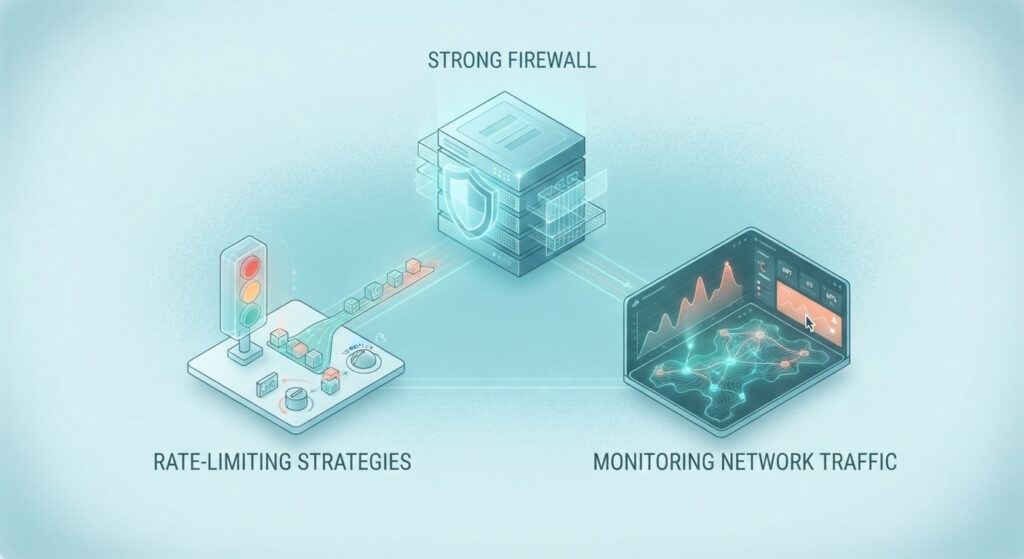
Using a Strong Firewall
Namely, a solid firewall is your first line of defense, and it can deter any malicious connection requests before they even have the chance to affect you.
Rate-Limiting Strategies
This type of protection puts a cap on how many requests your server can receive within a particular period.
After all, if you set a clear limit, you can prevent overburdening your server. As a result, DDoS attacks won’t have any effect.
Even more importantly, legitimate users will be able to visit your site without any issues.
Monitoring Your Network Traffic
You should always keep an eye out for sudden spikes in traffic and have a clear-cut response plan in case of attacks.
That way, you will be prepared to mitigate the attacks as soon as they occur, and you will know exactly which steps to take.
Use Abelohost’s DDoS-Protected Hosting Plans
If the abovementioned steps seem intimidating—or if you simply don’t know where to start—choosing hosting services with integrated DDoS protections is the best option.
Abelohost’s DDoS-protected hosting plans offer you the best of both worlds: reliable and secure hosting services along with robust DDoS protection.
Our plans are safeguarded by an advanced defense network that silently absorbs and deflects these attacks.
All the while, it imposes no bandwidth caps or extra fees when threats hit. Plus, there are no dangers to your site’s performance, as our infrastructure works independently of these protections.
This type of advanced DDoS protection is available with all our plans, be it shared, VPS, or dedicated hosting.
It makes your job infinitely easier: by allowing us to detect and mitigate any threats, you save precious time that you can dedicate to growing your business.
Conclusion
Distributed-denial-of-service (DDoS) attacks are grave threats that can seriously affect any website, application, or service.
In order to defend your platform from them, recognizing them, understanding their impact, and deploying appropriate protections is crucial.
The easiest (and safest) way to achieve all three is to commit to a DDoS-protected hosting plan.
Reach out to us—we will give you all the necessary information, go in-depth into DDoS threats, and explain how our detection and protection services work.
Together, we will safeguard your platform and ensure that DDoS attacks can never disrupt your services.
Author
Monica Jansen
Monica Jansen is a seasoned tech writer focused on web hosting and cybersecurity. She loves doing deep dives and whittling down difficult topics into simple and succinct concepts. Whether she is covering firewalls or different hosting plans, she always strives to provide clear guides that website owners of all skill levels can follow.
Add your comment
Get content delivered straight to your inbox



Your data.
Your choice.
Work with the best of the best — your projects deserve it.