Back to Blog


Monica Jansen
Sep 28, 2026
What Is AI Model Deployment?
AI models are rapidly changing how we interact with technology and what it can do.
From recommendation engines to fraud detection and voice assistants, deployment is what allows these models to power many of the tools and services we use every day.
In this guide, we’ll take a closer look at AI model deployment, including how it works, the different types and strategies, and key factors to consider.
- Understanding AI Model Deployment
- Why AI Model Deployment Matters
- Model Deployment vs. Model Serving
- Types of AI Model Deployment
- Tools and Frameworks
- Considerations Before Deployment
- Considerations After Deployment
Understanding AI Model Deployment
AI model deployment connects a trained model to the environment where it will actually be used.
It involves integrating the model with the systems and resources it needs to operate outside development.
Once available, a model can:
- Generate predictions
- Classify information
- Provide recommendations
- Perform other tasks it has been trained for
However, real-world conditions can vary significantly from those the model was built and tested under.
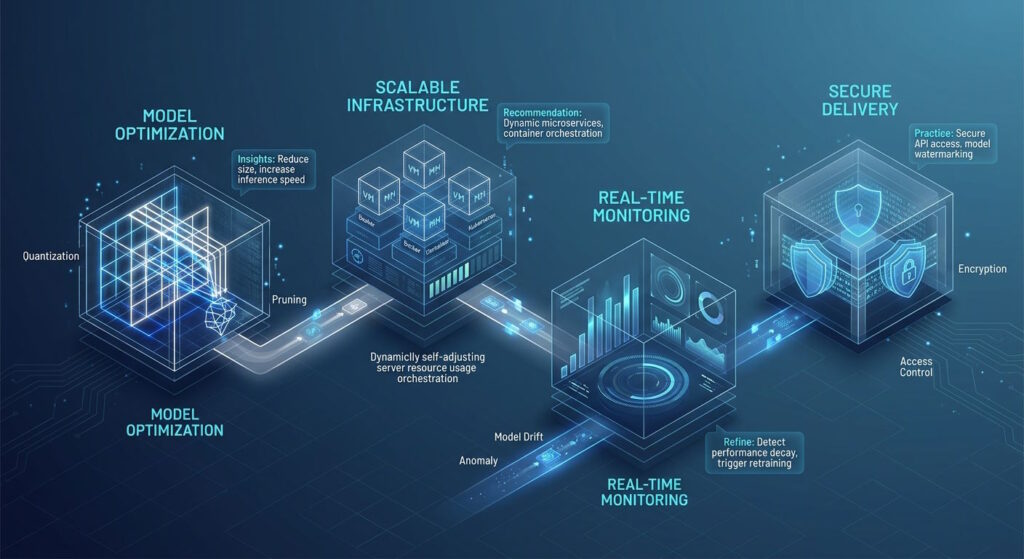
To account for these differences, the deployment process often involves packaging the model, setting up the infrastructure, configuring model serving, and testing and monitoring performance.
Together, these stages help ensure the model can handle actual workloads and perform reliably once deployed.
Why AI Model Deployment Matters
AI model deployment allows organizations to turn a model’s capabilities into practical business value.
Once integrated into real operations, models can:
- Automate repetitive tasks
- Support faster analysis
- Provide business insights
Additionally, deployment can improve customer-facing applications through more relevant recommendations, quicker responses, or other AI-powered features.
Beyond immediate uses, putting models into practice creates opportunities to refine existing processes and introduce new capabilities as business needs evolve.
Without effective deployment, even a highly functional model may remain little more than an experiment with limited impact outside development.
Model Deployment vs. Model Serving
Although closely related, deployment and model serving have different purposes and shouldn’t be used interchangeably.
A deployed model doesn’t necessarily need to handle incoming requests.
It can automatically perform tasks, such as processing data at scheduled intervals and storing the results.
On the other hand, model serving comes into play when the model needs to respond to input as it arrives.
For example, an application can send data to the model and receive a prediction or other output.
Simply put, deployment is the broader concept, while serving provides a way for users or applications to interact with the model.
Types of AI Model Deployment
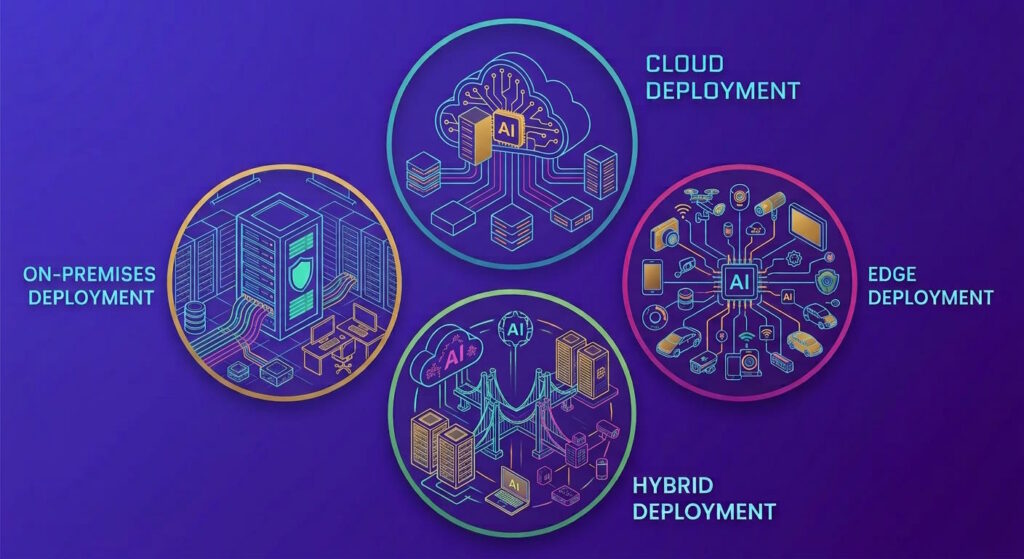
AI models can run in different environments, from remote infrastructure to local systems and devices.
Each option comes with different considerations around performance, infrastructure, scalability, and data privacy.
Some of the most common deployment types include the following:
Cloud Deployment
Cloud deployment runs the model on infrastructure provided by a cloud service rather than on local hardware.
Computing resources can be increased or reduced as demand changes, making it suitable for models with fluctuating usage.
On-Premises Deployment
On-premises deployment keeps the model and its supporting infrastructure within the organization that is running it.
It provides greater control over systems and data, which can be particularly important for models handling sensitive or confidential information.
Edge Deployment
Edge deployment runs the model locally, either directly on the device or close to where the data is generated.
Processing data at the source can reduce latency, making it useful for applications that need fast responses.
Hybrid Deployment
Hybrid deployment combines local and cloud-based resources within the same AI system.
It offers more flexibility for models that handle sensitive data but also require substantial computing resources.
Deployment Strategies
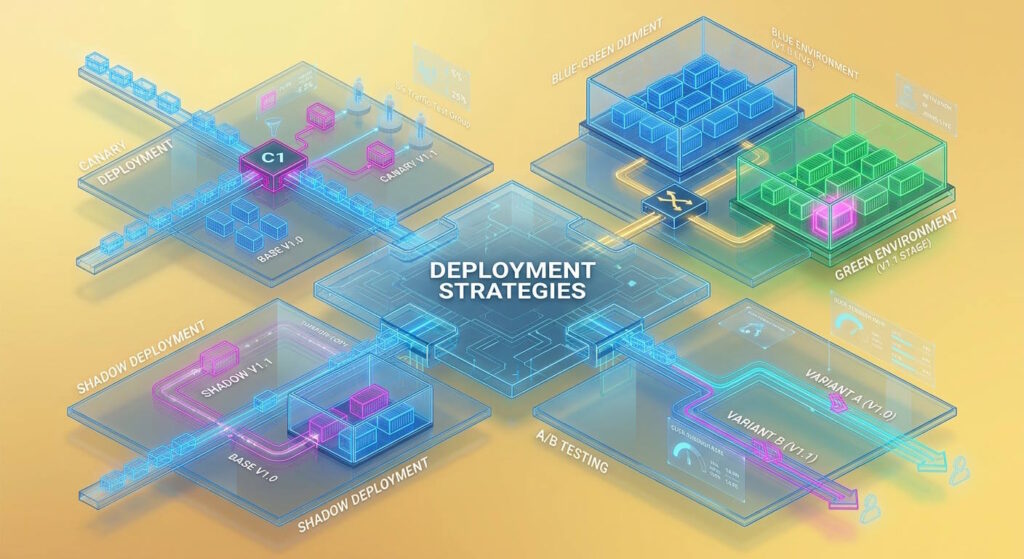
While deployment types describe the environment the model runs in, deployment strategies determine how a model or a new version is introduced.
Different strategies can control how gradually a new model is rolled out. When replacing an existing one, they can also allow the changes to be tested before making a full transition.
Among the key strategies are:
Canary Deployment
Canary deployment introduces a new model to a small portion of users prior to expanding the rollout.
Therefore, any problems can be identified before the model reaches a wider audience.
Blue-Green Deployment
Blue-green deployment uses two identical setups—one runs the current model for users, while the other holds the updated version separately.
Once the new model is ready, traffic is switched between the setups, allowing the previous version to remain available for a quick rollback if needed.
Shadow Deployment
Shadow deployment runs a new model alongside the existing one, with both receiving real-world inputs.
However, users only see the results from the existing model, while the new model’s outputs are logged for evaluation.
A/B Testing
A/B testing divides users between two model versions, with each version handling its assigned group.
The goal is to compare their results and determine which performs better based on the chosen metrics.
Tools and Frameworks
Different tools can support individual parts of AI model deployment rather than one platform necessarily handling the entire process. Some common categories include:
- Model registries: Used to track models, their versions, and deployment history. For example, MLflow Model Registry can record which version is currently in use and how it has changed over time.
- Experiment tracking tools: Information about training runs, parameters, and results can be recorded throughout model development using platforms like MLflow Tracking.
- Feature stores: Consistent data features between training and production can be maintained with tools such as Feast, reducing the risk of differences between the two environments.
- CI/CD tools: Parts of the testing and release process can be automated through platforms such as GitHub Actions or Jenkins, including validating changes before a new model version is introduced.
- Serving frameworks: Trained models can be made available to process incoming requests. NVIDIA Triton, for instance, can serve models from different AI frameworks across various types of hardware.
Considerations Before Deployment
Preparing a model for production involves several factors that need to be addressed before release.
Production Requirements
Before deployment, it is important to consider the practical requirements of running the model in a production environment:
- Performance: The model’s expected workload and response speed determine the computing resources needed to deliver results without unnecessary delays.
- Scalability: Potential changes in usage should be accounted for so the setup can handle increases in demand without causing disruptions.
- Privacy and security: Handling sensitive or confidential data may require stricter controls over where information is stored, how it is transferred, and who can access it.
- Cost: Computing power, storage, and usage all contribute to ongoing expenses, so the resources needed to keep the model running should be factored into the overall cost.
Preparation
Firstly, the complete setup needs to be tested under conditions that reflect how the model will actually be used.
This can uncover problems with connections, dependencies, or interactions between components that may not appear during development.
Additionally, integrations with applications, APIs, databases, and other systems should be checked before release to confirm that they work as expected.
Lastly, responsibilities for the model should be established in advance, including who will oversee it and respond if problems arise once it is running in production.
Considerations After Deployment
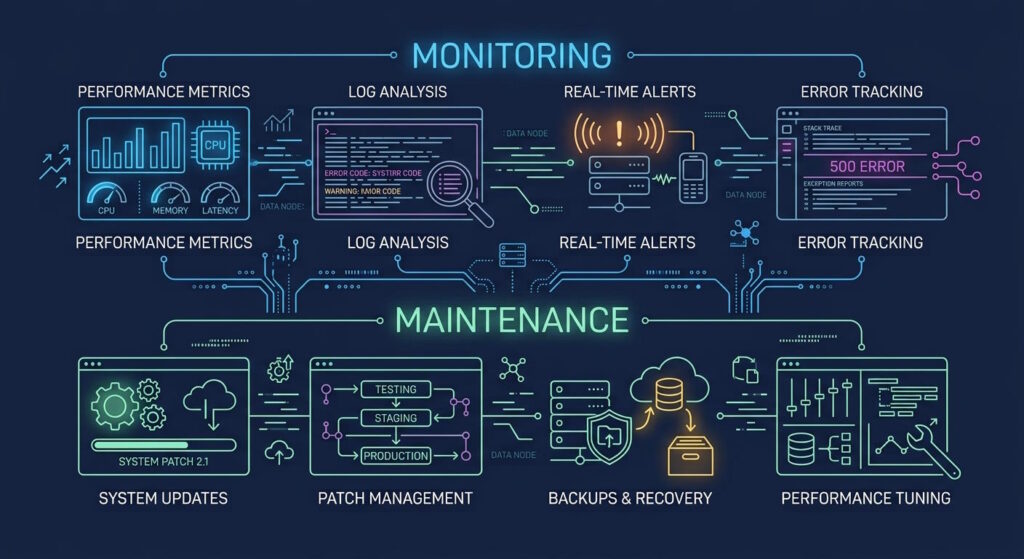
Following deployment, ongoing oversight helps ensure the model continues to meet its intended purpose as conditions change.
Monitoring
To begin with, performance should be tracked against the expectations established prior to the release.
Changes in accuracy, response times, error rates, or other relevant metrics can indicate that the model is no longer performing as expected.
Another important factor is model drift, which can occur as incoming data or real-world patterns change.
Identifying these shifts can help determine when declining results are linked to conditions the model was not originally trained on.
Maintenance
Over time, new data or evolving requirements can make retraining or updating the model necessary.
In addition, modifications to applications, data sources, libraries, or other dependencies may require adjustments to keep the model working correctly within the wider system.
In some cases, models that no longer produce desired results may need to be replaced or retired rather than continually updated.
Conclusion
AI model deployment can have a lasting impact on how well a model performs after development.
The best results come from matching the setup to its workload, data, and changing demands.
With the right approach, deployment can turn a trained model into a dependable part of everyday operations.
Author
Monica Jansen
Monica Jansen is a seasoned tech writer focused on web hosting and cybersecurity. She loves doing deep dives and whittling down difficult topics into simple and succinct concepts. Whether she is covering firewalls or different hosting plans, she always strives to provide clear guides that website owners of all skill levels can follow.
Add your comment
Get content delivered straight to your inbox


Your data.
Your choice.
Work with the best of the best — your projects deserve it.